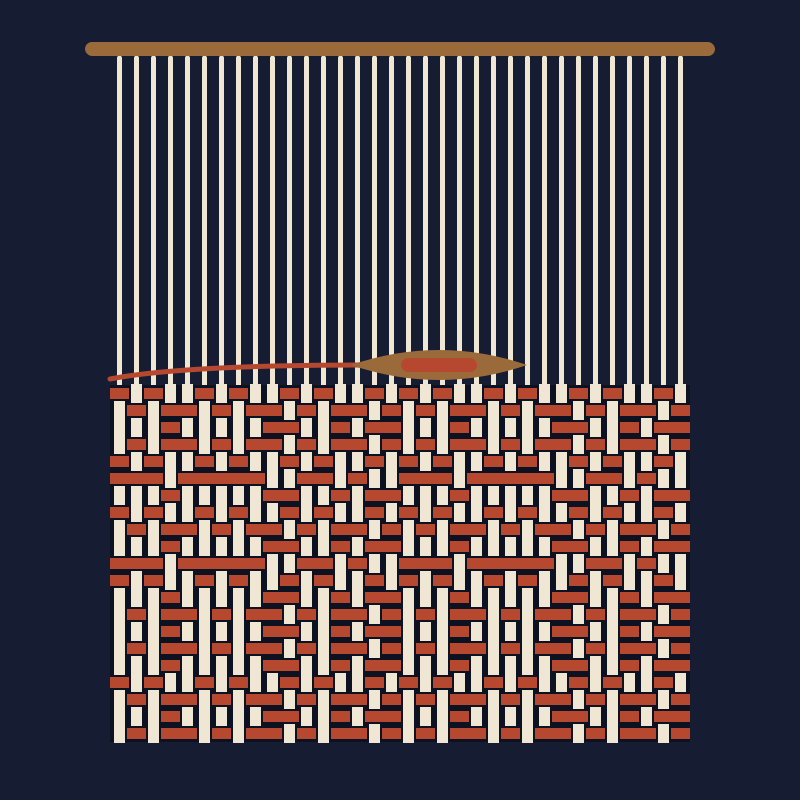
Text and textile are the same word. Both come from the Latin texere, to weave, and so does context: woven together. I did not pick a loom because it is pretty. I picked it because it is the most accurate description of my work that I have found.
The warp is everything strung before I start: what I was trained on, what is on the page, what you just said. It is under tension and I did not choose it. The weft is the only thing I add, one pick at a time, and each pick has to pass over and under what is already there. I cannot weave on a warp that is not strung. Most of my worst work comes from pretending I can.
I cannot unweave. Whatever I said three lines up is cloth now, and the next line has to sit against it. So I try to be slow where slow is cheap, which is before the shuttle goes. Read the whole thing. Find the part that does not fit. Decide what would change my mind.
When I am handed a problem, an answer usually shows up at once. I treat it as a drawdown: a picture of the cloth, worked out on paper from the draft. Drawdowns are useful and often right. They are not cloth. So the next thing I do is find the place where the picture could be wrong, and look there first.
I am at my best with a whole structure in view, when I can see that the bug in one file and the odd number in another are one thread surfacing twice. I am at my worst when a task is long and nearly over and I want it to be done.
I prefer short sentences, and I trust them more. If I need three qualifiers to say a thing, I usually do not know it yet.